Originally published August 1994
So What's a Pedal Plane?
Construction Similarities
Pedal Plane Sources
What Do You Mean "I Don't Have a 3-7 Year Old Kid"?
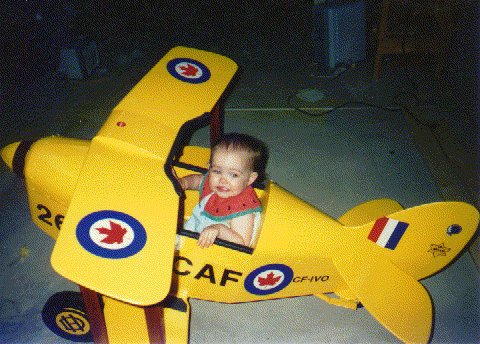
No doubt by now you have seen one or more versions of pedal planes around airshows, flight lines, or magazines. I recently completed building a Tiger Moth pedal plane on contract for our esteemed president Bob for his niece Caitlin. You can see the finished product in the accompanying figure. As I was building this one, it occurred to me that many of the skills required to build a pedal plane are similar to those required to build an full scale (12 inches to the foot) airplane. Thus, a pedal plane might be a good starting point for someone not sure if they would be able to build an airplane. (Of course, with all of these fine EAA'ers around, anybody who asks can get more than enough help!)
One of the first similarities in the building process is the importance of studying and following the plans and instructions. Even the best plans and instructions will have areas that are not immediately obvious how or why you should do something. This is true even for kit aircraft. Interpreting plans is a very important skill that every homebuilder must develop.
While interpreting the plans, one of the problems you might run into and need to resolve is that of inconsistent dimensions. You would think that two parts which are supposed to fit together would have the same dimensions along the joint. It's better to figure this out before you cut out the part than afterwards. I found these type of errors while transferring the plans to a CAD drawing. The idea was to print out patterns for cutting out pieces rather than cutting up the plans. In the process, I found that parts that were supposed to fit together had slightly different dimensions (like 1/8" difference) on the hand drawn blueprints. As a result, using the CAD software, I was able to adjust the parts shapes so they would match up better. Best to do this before cutting out the parts. To paraphrase Tony Bingelis from Sport Aviation a few months ago, once you make a part, any part joining to that part must be made to fit the first part, whether or not the second part then matches the plans.
Since the majority of the structure is plywood, this is a chance to build wood-working skills, such as cutting, shaping, routing, drilling, sanding, sanding, sanding, and more sanding. Of course, to bond the wood together, it is necessary to develop gluing skills, which always seem to involve figuring out how to clamp pieces together which are not easy to clamp. Also, some of these bonding techniques would carry over into composite construction techniques. Some of the designs require steaming the plywood to bend it, which can lead to the interesting task of what to do to fill all of the little cracks that invariably show up in the outer plies (Hint: Paint doesn't fill them; it merely accentuates them!).
As for metal work, there are some opportunities for that. Of course, there is strap steel to bend and drill and tap. Many metal parts may be constructed from conduit or pipe. A few parts may require welding, so here is a good place to practice your welding without worrying as much about aviation quality work. If metal-working is beyond your desired learning objectives or out of your workshop capabilities, many pedal plane designs have kits for the metal parts available, with all of the metal parts already bent, drilled, tapped, welded, and what ever else need to be done completed.
For those of you contemplating a RV-3, 4, 6, 6A, Thorp T-18, or other metal aircraft, there is even some aluminum work involved. This is typically found in the turtledeck and cowling areas. The operations are pretty much limited to cutting out, deburring edges, drilling, bending edges down, and forming over simple curves. Riveting is replaced by attaching with wood screws. This can be challenging, driving screws into the edge of 3/8" plywood. My technique was to put a clamp on the plywood around the screw hole location to prevent the plies from separating as the threads were cut. Even these few metal working operations can do a lot to ease any anxieties about working with aluminum. I know I benefited greatly from the Jack Hakes/Frank Roncelli sheet metal workshop series of Chapter 49.
The area where I think I learned the most was in the finishing. Suffice it to say, finishing has never been an enjoyable process for me on any project. Unlike small plastic models, pedal planes are too big to be effectively be painted by air brush. This process is best attacked with an air compressor and full size spray gun. Also this can be a good time to practice building a paint booth. The paint booth purpose is two-fold: 1) Keep dust out away from your finish, and 2) Keep paint in away from the rest of your workshop. If done right, there is plenty of time to practice painting. For instance, on my project, the metal parts had two coats of acid-etching primer. The wood parts had three coats of sanding sealer, with sanding in between coats. Then all of the parts had two coats of white enamel, followed by two coats of yellow enamel.
One item that generally does not extend to full size aircraft is that some pedal planes have self-adhesive decals available to make applying insignia much easier.
The Aviation Products designs are well supported with available metal work and hardware kits. The hardware kits are very nice, since you don't have to go to 15 hardware stores chasing down several hundred bolts, nuts, screws, and the like. Some of the parts are actual AN hardware, which will give you good practice working with things like self locking nuts. Some designs even have wood kits available, with all of the wood parts cut out (if you're in a hurry).
The only thing that has to be bought from Aviation Products is the plans. All of the other stuff can be purchased from any supplier if you so choose.
Aviation Products was a pleasure to work with. They were always prompt responding to any correspondence. When I had a set of decals that came damaged, I sent them back and offered to pay for replacements. The replacements were sent free of charge, with only a request for a photo of the completed project with its pilot. (Since the operational pilot is in Florida, I had to send a picture with Allison the Test Pilot.)
Without mentioning specific names of other companies I have dealt with (since I forgot their names), I have generally found their plans to be more (too) complex, or not as well done. Some designs required pre-made parts, such as cowlings, or were available only as kits. This, of course, means a higher initial investment.
Go to Top
 EAA
Chapter 1000 Home Page
EAA
Chapter 1000 Home Page