Russ Erb
Originally published May 1994
Design Considerations
Analysis Conditions
Analysis Program
Lift, Drag, and Moment Curves
Pressure Distribution
In Summary
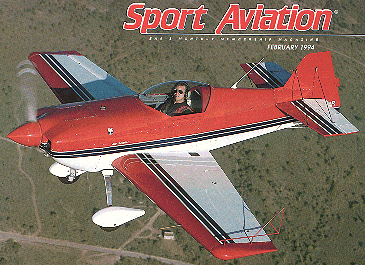
One of the latest aircraft to hit the aerobatic circuit is the cleverly named "One Design," prominently featured on the cover and in an article in the February 1994 Sport Aviation. While I'm sure you read the article with great interest, you probably missed a subtle but important design feature of this aircraft. I say this fairly confidently because I missed it too. It was brought to my attention during discussions with Project Police officer and Chapter 1000 President Bob Waldmiller. Officer Waldmiller had seen the One Design at Oshkosh, where he noted the unusual airfoil shape.
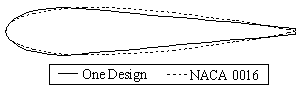
According to the article in Sport Aviation, the wing uses a "specially designed symmetrical airfoil, 16% thick, conical nose and flat sides." According to Bob, the front part of the airfoil appeared to just be an ellipse. The trailing edge appeared to be a flat vertical surface about one inch high. The rear part of the airfoil was just a straight line tangent to the ellipse running back to the trailing edge. All of this matched, since an ellipse is a conic section.
Based on these data and careful study of the pictures in Sport Aviation, I came up with an estimated description of the One Design airfoil. For this study, I decided to compare the airfoil with a well known, well documented airfoil shape, the NACA 0016. The airfoil parameters are listed in Table 1. The One Design airfoil is shown compared to a NACA 0016 airfoil in Figure 1. Note that both airfoils are symmetrical and have the same thickness.
| One Design Airfoil | |
|---|---|
| Ellipse Major Axis | 40% chord |
| Ellipse Minor Axis (Thickness) | 16% chord |
| Location of Maximum Thickness | 20% chord |
| Location of Tangent Point, Ellipse and Straight Portion | 25% chord |
| Trailing Edge Thickness | 2% chord |
| NACA 0016 | |
| Thickness | 16% chord |
| Location of Maximum Thickness | 30% chord |
Figure 1. One Design and NACA 0016 Airfoil Comparison
Since most airfoils consist of smoothly flowing curves, Bob and I began to wonder why this airfoil was so different. As is the case with most aircraft designs, the reasons for the design can normally be found in an understanding of the design mission of the aircraft.
From a construction standpoint, the One Design is intended to be built by amateurs at relatively low cost. The wing is all wood with plywood covering. The conical shape of the leading edge means that there are no compound curves to shape the plywood around. This alone can make a significant reduction in the difficulty of construction. The aft portion of the wing should be very easy to cover because of the straight portion of the ribs.
Even so, ease of construction is not significant enough a reason to drive an airfoil design. We must also look at the aerodynamic requirements of an aerobatic wing. Many of us would immediately think that the wing must be able to provide high lift to generate the high load factors required for aerobatic maneuvers.
Less obvious is the requirement to have a sharp, well defined stall. This requirement can be seen in several of the aerobatic maneuvers which consist of departures, including snap rolls, spins, and Lomcevaks. Consider the snap roll. In a snap roll, the nose of the aircraft is pulled up sharply as the stick is slammed to the side. Pulling the nose up increases the angle of attack on the wing. Rolling to the right decreases the angle of attack on the left (upward-moving) wing, but increases the angle of attack on the right (downward-moving) wing. This increase in angle of attack causes the right wing to stall, greatly decreasing its lift. The left wing is still flying, such that the resulting moment is much greater than is possible with the ailerons alone. If the right wing was slow to stall, the snap roll would be more difficult if not impossible to accomplish.
Drag is not as important a factor for aerobatic aircraft as it is for aircraft designed for long-range cruise. In vertical climbs to a hammerhead stall or other maneuvers, the airspeed drops to low values, where drag is thus low because of the low velocity. In this case, the driving parameters are engine power and how effectively the propeller turns that power into thrust. In vertical dives, higher drag is actually beneficial as it keeps the airspeed from building up too fast. The airfoil of the One Design is in fact the antithesis of typical low drag laminar flow airfoils. Laminar flow airfoils usually have the location of maximum thickness well back on the airfoil. This creates a long favourable pressure gradient, which delays transition from a laminar to a turbulent boundary layer. A favourable pressure gradient occurs where the static pressure drops as the flow progresses. This is accompanied by an increase in velocity. Air will quite happily travel through a favourable pressure gradient, just like air flowing out of a balloon. It is the air flow equivalent of water flowing downhill. However, the One Design airfoil has the location of the maximum thickness fairly far forward, making the region of the favourable pressure gradient fairly short. This will cause higher skin friction drag than laminar flow airfoils, but for this application, this is desirable or at least not objectionable.
Due to the high load factors required in aerobatics (the One Design is designed for 10 g's), the wing must be very strong. One method to accomplish this would be to use exotic materials, such as carbon fiber composites. However, this would be expensive, require special fabrication techniques, and could result in a thinner wing (which would reduce drag). All of these results would actually be undesirable for this mission. The alternative method is to use conventional materials (in this case wood) and build a thicker wing. As such, the One Design has a relatively thick wing with a 16% chord thickness.
Studying the performance data listed in Sport Aviation and exercising my virtually non-existent knowledge of aerobatics, the conditions in Table 2 were chosen as appropriate for analysis.
| Weight | 1000 lbs |
| Wing Span | 19.5 ft |
| Wing Area | 75.55 ft2 |
| Aspect Ratio | 5.03 |
| Reference Chord | 3.877 ft |
| Span Efficiency Factor | 0.8 (estimated) |
| Altitude | Sea Level |
| Atmospheric Conditions | Standard Day |
| Density | 0.0023769 slug/ft3 |
| Viscosity | 3.7466 x 10⁻⁷ slug/ft-sec |
| Speed of Sound | 1116 ft/sec |
| Velocity | 120 mph (176 ft/sec) |
| Mach | 0.1577 |
| Reynolds Number | 4328944 |
| Grit location (Re=500,000) | 11.55 % chord |
| Lift Curve Slope | .06881 /deg |
| Stall Speed | 60 mph (88 ft/sec) |
| Stall CL | 1.4 |
| Stall AOA | 20 deg |
The reference chord was calculated based on the wing span and aspect ratio. The span efficiency factor was estimated based on the wing planform. The span efficiency factor was only used in the lift curve slope calculation, which was used to determine the stall angle of attack. The flight condition was chosen at sea level on a standard day. The airspeed of 120 mph was chosen as a midrange speed between the 75% power speed of 160 mph and the stall speed of 60 mph. The grit location, where the boundary layer was tripped from laminar to turbulent, was based on the location for a Reynolds Number of 500,000, which is the typical location for transition on a flat plate.
For this analysis, the airfoils were analyzed using PANDA, a Program for ANalysis and Design of Airfoils, version 1.1. This program runs under Microsoft Windows, and is marketed by Desktop Aeronautics, P.O. Box 9937, Stanford, CA 94305 (415-424-8588)
PANDA "computes and graphically displays the pressure distribution on airfoil sections in subsonic flow...the program calculates the inviscid pressure distribution over the airfoil at a specified angle of attack and Mach number; lift and pitching moment about the 1/4-chord point are also computed...The program also computes the boundary layer properties based on this inviscid pressure distribution. The location of transition, laminar or turbulent separation, and total drag are computed based on integral boundary layer methods." (PANDA Users Guide)
On a side note, probably the best part of the manual is the warranty statement: "...We have tried to test the program thoroughly but you never know. We are not liable for damages resulting from any defect in the software or manual--not even if the program causes your computer to blow up and your house burns down. Anyway, we don't have enough money even to pay the lawyers."
By the way, if you buy your computorial equipment from a fruit vendor, there's a version of PANDA for you too. In fact, the Windows version was ported from the original Macintosh version.
As you look at the results from the analysis and compare them to the actual aircraft numbers, don't be surprised that the numbers don't match exactly. The primary reason for this is the values for the aircraft are for a 3-dimensional wing, with wing tip vortices and other real world effects. The analysis values are for a 2-dimensional airfoil, or a wing with infinite span. The important things to note are the trends, or how values change. The trends should be the same for both cases.
So how do we compare these two airfoils? Well, we might as well start by comparing the lift, drag, and moment curves. The lift coefficient vs. angle of attack is not shown in any figure, since on a full page graph of these curves for the One Design Airfoil and the NACA 0016, the maximum difference between the curves is about two pixels. Basically, the change in lift coefficient with angle of attack is identical for both airfoils.
So if the advantage is not in lift, what about drag? Figure 2 compares the drag coefficient vs. angle of attack for both airfoils. Again, the drag coefficients are very close, with the One Design airfoil actually having slightly lower drag at low angles of attack. However, the NACA 0016 was never designed as a laminar flow airfoil, and there are other airfoils with lower drag.
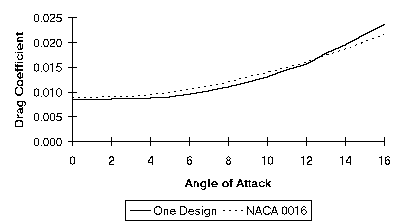
Figure 2. One Design and NACA 0016 Drag Coefficient Comparison
Figure 3 compares the moment coefficient about the quarter chord of the two airfoils. PANDA predicts a slightly varying moment coefficient for the NACA 0016, while NACA experimental data in Abbott and Von Donhoff's Theory of Wing Sections shows a constant moment coefficient equal to zero. The slightly positive pitching moment of the One Design airfoil would help with maneuvering the aircraft, but is small enough to be negligible. At 15 degrees angle of attack, the pitching moment from the wing would only be about 65 ft-lbs, or about how tight you tighten the lug nuts on your car's wheels.
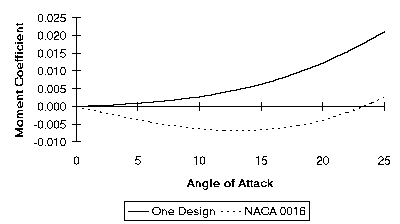
Figure 3. One Design and NACA 0016 Moment Coefficient Comparison
So if there is not a big advantage of the One Design airfoil in lift, drag, or moment, where does its advantage lie? The answer can be seen by looking at the pressure distribution over the airfoil. As you no doubt remember from Private Pilot Ground School, an airplane flies because there is a higher pressure on the lower surface of the wing than on the top surface. The pressure is lowered because the local velocity of the air is increased by the shape of the airfoil. To express this change in pressure with a non-dimensional coefficient, aerodynamicists use the Coefficient of Pressure, which is defined as
![Cp = (P - P[inf]) / q[inf]](cpeqn.gif)
where
| P | Local Static Pressure |
P | Freestream Static Pressure |
| q | Freestream
Dynamic Pressure  |
So what does this mean? Note that P
and q are constants.
The only variable in the pressure coefficient definition is the
local static pressure. As the velocity increases, the local static
pressure drops, and the pressure coefficient becomes more negative.
The pressure coefficient distribution for the NACA 0016 at 2 degrees
angle of attack is shown in Figure 4.
Note that CP distributions are traditionally plotted
upside down, with CP becoming more negative upwards.
This gives a more intuitive picture, with the upper surface CP
being above the lower surface CP. In this article,
"upward" references to a pressure coefficient plot will
mean toward the top of the page. The area between the curves represents
the aifoil's lift. The bigger the area, the greater the lift coefficient.
Positively sloped lines (in the traditional sense) near the front
of the airfoil (0% chord) denote a favourable pressure gradient.
As mentioned before, air will quite happily flow through a favourable
pressure gradient, as the pressure drops and the velocity increases.
This is equivalent to washing the roof of your car, where the
water happily flows down over the windshield. Negatively sloped
lines, such as those over the rear half of the airfoil, denote
an adverse pressure gradient. In this region, the pressure is
increasing, and the velocity is decreasing. This area is equivalent
to rinsing the hood of your car. If the water stream has enough
velocity, it will travel up the windshield against gravity. As
it travels up the windshield, the water will slow down. If the
windshield is tall enough, the water would eventually stop and
run back down. This would be equivalent to the air separating
from an airfoil, which results in a stall. As the strength of
the adverse pressure increases, the separation point moves forward
on the airfoil.
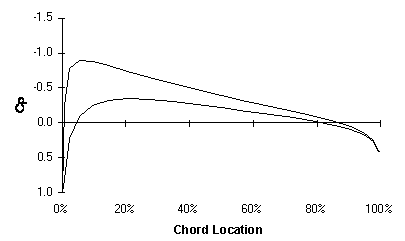
Figure 4. NACA 0016 Pressure Coefficient Distribution, Angle of Attack = 2°
Figure 5 shows the pressure coefficient distribution for the One Design airfoil at the same 2 degrees angle of attack. Several differences from the NACA 0016 are noticeable. From about 10% to 40% chord, the One Design airfoil has a much steeper adverse pressure gradient. As a result, the air velocity from about 30% to 80% chord is less than for the same location on the NACA 0016. Since the air has less momentum, it will be more likely to separate and stall.
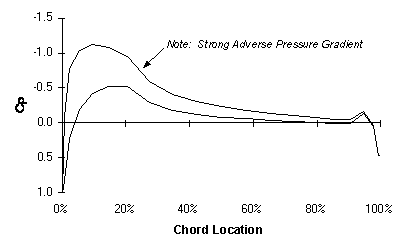
Figure 5. One Design Airfoil Pressure Coefficient Distribution, Angle of Attack = 2°
Over the rear of the airfoil, the difference between the upper and lower surface CP is less than the difference at the same chord location for the NACA 0016. Since the lift coefficient is equal for both airfoils at the same angle of attack, the area between the pressure coefficient lines must be equal. Therefore, we can conclude that the area between the pressure coefficient lines for the One Design airfoil is more toward the front of the airfoil. This difference explains the difference in the moment coefficient curves for the two airfoils.
The last difference to note is the small rise in the pressure coefficient between 90% and 100% chord. I suspect that this rise does not happen in reality, but is a limitation of the analysis method. PANDA requires that the coordinates for the upper and lower surfaces end at (100%, 0). This is not a problem for normal airfoils with sharp trailing edges. However, PANDA will not accept a blunt trailing edge such as on the One Design airfoil. As such, PANDA fits a smooth spline and puts a sharp trailing edge on the airfoil. This change in geometry causes this rise in CP, and should be ignored.
Figure 6 finally reveals the main reason for the One Design airfoil's unusual shape. This graph shows the location of the upper surface separation point. As this point progresses forward on the airfoil, the airfoil becomes progressively more stalled. Figure 6 shows that the upper surface separation point moves smoothly forward on the NACA 0016, which would cause buffeting and thus stall warning for several degrees angle of attack prior to stall. For normal category aircraft, this is a desirable characteristic. However, on the One Design airfoil, the flow over the upper surface stays attached up to about 15 degrees angle of attack. Above 15 degrees angle of attack, the separation point moves quickly forward, resulting in a very sharp stall. As mentioned earlier, a sharp stall is very desirable for an aerobatic aircraft.

Figure 6. Chordwise Location of Upper Surface Separation Point
So we can see that the One Design Airfoil is well suited to the aerobatic mission. The lift, drag, and moment characteristics are comparable to other airfoils. The simple geometric shape allows easy construction. The One Design Airfoil is capable of producing as high a lift coefficient as other airfoils, which is required for high-g maneuvers, while giving a sharp stall necessary for crisp snap rolls, spins, and Lomcevaks. This sharp stall makes this airfoil unsuitable for normal category aircraft, but highly desirable for aerobatic aircraft.
 EAA Chapter 1000 Home Page
E-Mail: eaa1000@pobox.com
EAA Chapter 1000 Home Page
E-Mail: eaa1000@pobox.com